Underground tunnels and arena floor: the hypogeum walking route
The hypogeum is the two-level service chamber under the arena where the stage machinery, cages, trap doors and gladiator lift shafts lived. It is the second most interesting part of the Flavian Amphitheatre after the arena floor itself, and it is included in only two tiers of Colosseum tickets: Full Experience Underground + Arena at €24 and the Guided Tour at €32. Everything on this page comes from my five restoration cycles on the arena wooden floor and the hypogeum drainage programme.
What the hypogeum actually is
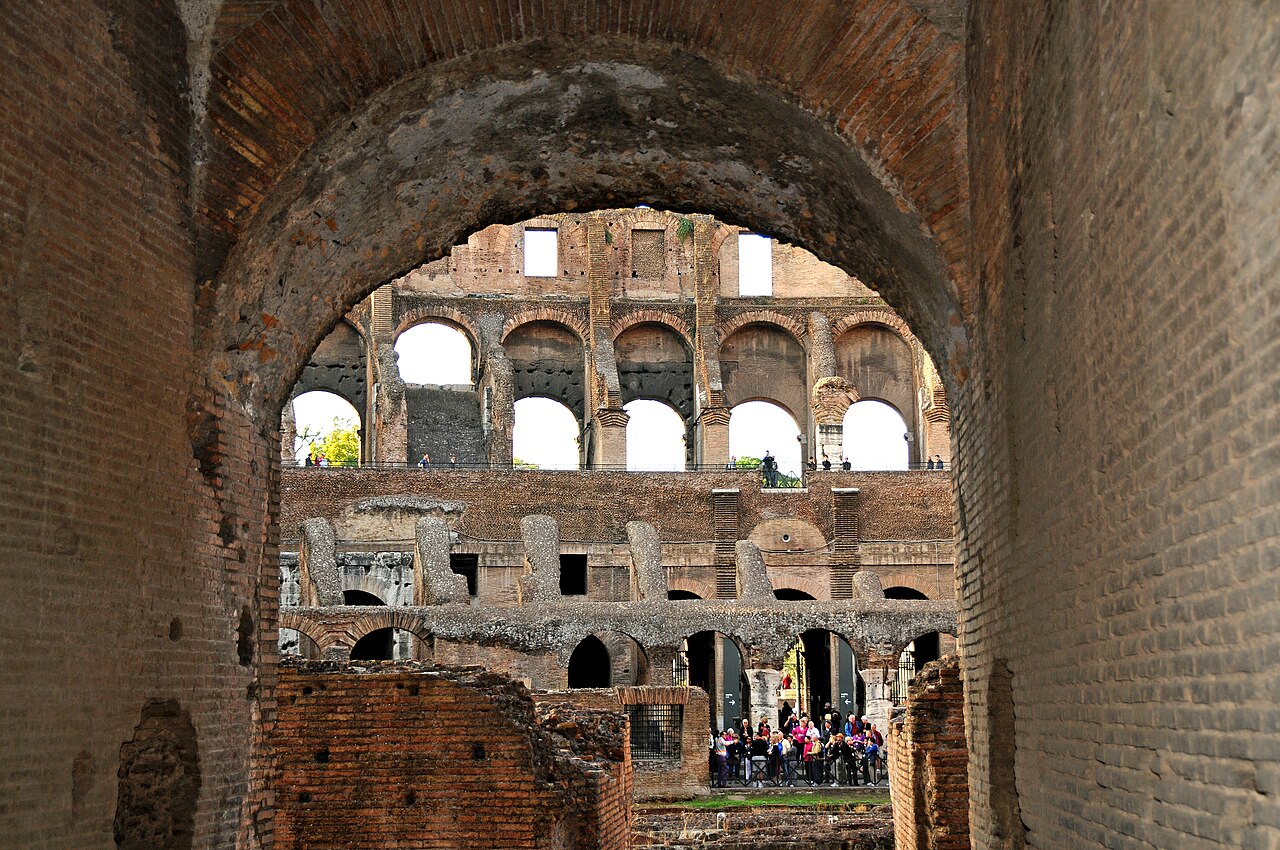
The hypogeum (literally ‘below the ground’) is a two-level grid of brick-vaulted corridors running the full length of the arena, about six metres below the original wooden floor. It had twenty-eight lifting mechanisms powered by counterweighted ropes and worked by teams of men on the lower level. Twelve of those lift shafts have been excavated and stabilised; four are open to visitors as viewing grilles on the walking route.
The hypogeum was added around AD 85 under Domitian, a few years after the amphitheatre was first dedicated, which is why the earlier ‘naval battle’ shows did not survive past Titus — the chambers filled the arena void permanently. The brick vaults you see today are mostly Domitianic. The marble dividers and some of the limestone sills are reused from Nero’s Domus Aurea next door.
The hypogeum walking route
You enter the hypogeum through the eastern wall, at the ground-level gladiator gate (Largo Gaetana Agnesi side). The walking route is a 350-metre flat concrete path laid over the original brick floor, with three short ramps no more than one metre rise each. There are no stairs on the hypogeum route itself.
The route follows roughly a shallow ‘U’: eastern spine, southern cross-corridor to the lift-shaft viewing grilles, then back along the western spine to the arena entrance. Stewards keep the groups soft (15–20 visitors) and rotate every 25 minutes so you never feel squeezed. Light is low in the original corridors — a mix of natural light through the surviving floor openings and warm LED uplighters pointed at the brickwork, not at your face.
The single most interesting stretch is the southern cross-corridor, where the sill of the central lift shaft is at waist height and the counterweight well drops three metres below you. The grilles on the openings are iron, modern, deliberately chunky — they are not meant to disappear visually, because the restoration team wanted the hypogeum to read as a live mechanism, not as a display.
Gladiator lift shafts and trap doors
The twelve excavated lift shafts show the original limestone runners, the cut slots for the wooden lift car, and in four cases the surviving bronze fittings for the counterweight rope. The restored trap door at lift shaft number four is the only one that visitors can see open and closed — it is cycled twice a day, at 11:00 and 15:00, as part of the stewards’ demonstration.
The lift cars themselves were timber platforms about 2 by 2.5 metres, counterweighted so one man on the lower level could raise a full load. The cages that rode the lifts held animals brought up from the menagerie storage under the southern arcade; the large predators (lions, leopards) came up near the eastern end, which is why that corridor has the heaviest sill stones.
The restored oak arena floor
The current arena wooden floor is a partial reconstruction installed in 2023 over an oak-and-steel sub-frame. It covers about one third of the original span — a wedge-shaped section on the eastern half — leaving the hypogeum open to view on the western side. The oak planks are 80 mm thick, machined to match the surviving dimensions on the twelfth-century engravings and the three fragments recovered from the drainage programme in 1998.
The floor is level and comfortable to walk. It is sealed against rain but the rain-drainage joint lines are visible — thin gaps every 3 metres run perpendicular to the long axis of the arena. From the arena floor looking west you see straight down into the hypogeum chambers, which is the single most memorable view in the entire visit for most visitors.
The 90-minute arena time limit
Your Full Experience or Guided Tour ticket includes 90 minutes on the arena floor. This is not a hard timer — stewards start rotating visitors off the arena about 20 minutes after your slot starts and finish before the next slot opens — but you should plan for roughly 70 productive minutes on the floor itself. There is one steward-manned exit (the eastern gladiator gate you came through) and no re-entry.
The underground walking route does not count against the 90 minutes; the hypogeum timer runs separately. In practice you will spend about 40 minutes underground, then 60–70 on the arena floor, then an hour on the upper tiers. Budget three hours for the full Underground + Arena visit.
Is the Guided Tour at EUR 32 worth the extra?
It depends on how much you have already read. If you have a good guidebook open on your phone and you are happy to look things up as you go, the Full Experience Underground + Arena at €24 is the better value. You walk the same route, see the same lift shafts, stand on the same arena floor — you just manage your own time.
If you are travelling with teenagers, or if this is your first visit to Rome and the names ‘Domitian’ and ‘Vespasian’ are not yet routine, the Guided Tour at €32 is worth the €8 premium. The licensed guides are properly trained, the 75-minute block is well-paced, and the group size (capped at 25) is small enough that you can hear the explanations under the brick vaults where the sound carries oddly.
Photographing from the arena
The arena floor is the best photograph of the amphitheatre you will take, in any light. The imperial box on the north wall, the senators’ rows on the south, and the slow curve of the travertine arches climbing to the attic all read clearly from the arena. Wide-angle lenses work — 24 mm equivalent is enough — but a 35 mm equivalent is often more flattering because it compresses less.
Light-wise, the first morning slot gives you the amphitheatre shadow still on the arena floor — dramatic but short. The last slot before sunset gives you raking light up the eastern tiers that is extraordinary from the arena looking west. Mid-day flat light is the worst; avoid 11:00–13:30 slots if you have a choice.
Tripods are not allowed on the arena floor (the wooden planking is restoration fabric and the stewards do not want point loads). Small travel tripods are tolerated on the upper tier stone but not inside the arena. Monopods are fine anywhere.
Mobility and stepping notes
The hypogeum walking route is the most accessible underground route in the amphitheatre: no stairs, three short ramps under 1 metre each, flat concrete surface. Wheelchair access is possible with a companion.
The arena floor has two steps up from the gladiator gate. These can be bypassed by stewards with a short portable ramp on request; ask at the arena gate.
Full visit length for the Underground + Arena tier is about three hours of walking. The upper tiers are accessed by stone stairs; the lift to the second tier is available with notice (request at the main entrance).