Attic and upper ring: the third-tier walkway
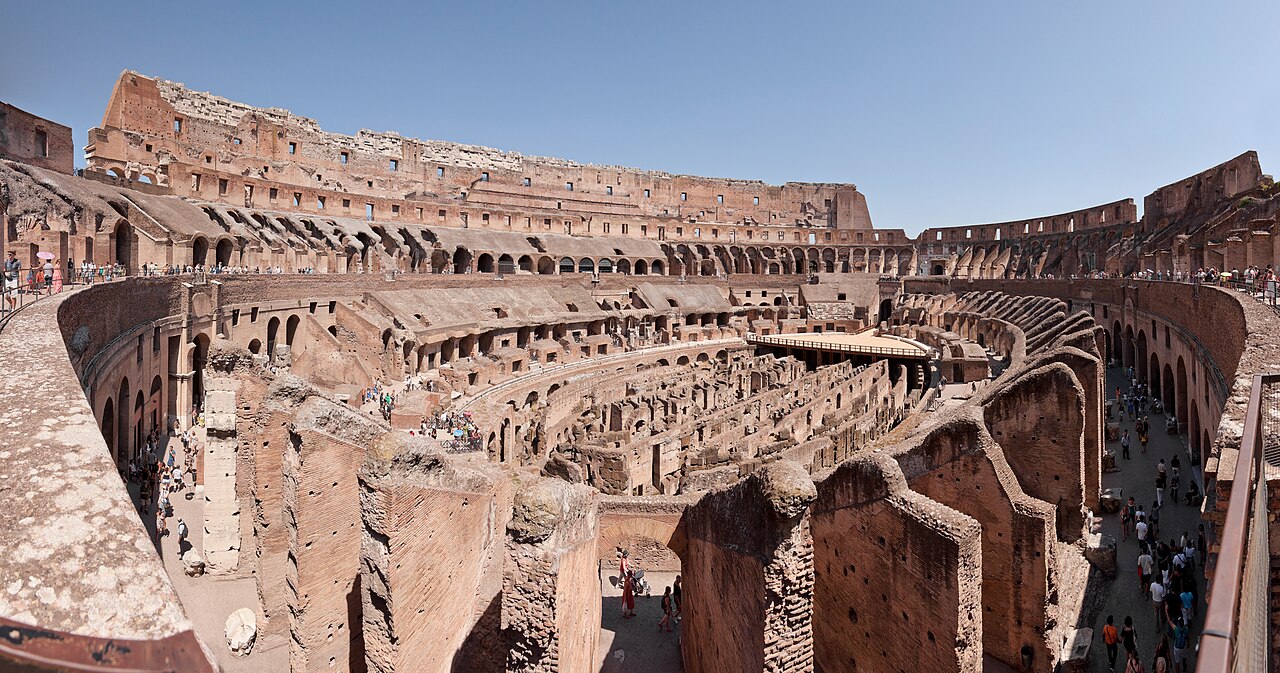
The attic is the fourth storey of the Flavian Amphitheatre — the plain wall above the three arched tiers, pierced by the small square windows that once held the awning masts for the velarium. The attic walkway, opened to visitors in 2017 and still the least-known part of Full Experience Colosseum tickets, is the single best view of the amphitheatre you will get at any price point. If I could pick one tier for a repeat visitor it would be the Full Experience Attic at €24 on the last slot before sunset.
What the attic actually is
The attic is the fourth structural storey of the amphitheatre, added by Domitian in the 80s AD above Vespasian’s original three arched tiers. Unlike the lower storeys it has no arches: it is a solid travertine wall faced in Corinthian pilasters, pierced by small square windows arranged in alternating pattern. Each window held the base of a mast for the velarium — the retractable canvas awning that shaded the audience. The brackets that supported the masts are still visible at the attic’s cornice, every three windows, carved into the travertine.
The walkway runs along the inside face of the attic, at the parapet height of the original top tier. You are standing on restored stone slabs over the original brick fill, looking out over the amphitheatre upper ring and the arena floor fifty metres below.
The attic walkway route
Attic access is reached by climbing three flights of stairs from the second tier — roughly 85 steps in total, on stone treads with iron handrails. There are no lifts. Visitors with mobility limits should pick a different Full Experience variant; the attic simply is not accessible without the climb.
The walkway itself runs along approximately one quarter of the attic circumference, on the north and north-east faces. The east stretch is the most interesting — it looks straight across the arena towards the Arch of Constantine and the Palatine ridge. The north stretch looks down the main axis of the arena and gives you the strongest sense of the amphitheatre as a single piece of architecture rather than as a ruin.
Walking length on the attic itself is about 140 metres return. Expect to spend 30–40 minutes on the attic walkway. You come down the same stairs you went up; there is no separate exit.
The 80-arch travertine ring seen from the attic
From the attic you can finally see the 80-arch travertine structure as its builders designed it. The three storeys of arches below you (Doric, Ionic, Corinthian) are arranged in a repeating module: 80 arches per storey, each arch exactly 7.05 metres wide at the base, each framed by the column order of its storey. Looking down the curve of the second tier you see every one of the surviving 31 arches on the north face at once.
You also see where the medieval quarry cut interrupted the ring on the south side — the darker brick on the south face is seventeenth- and eighteenth-century consolidation over the quarry wound. The attic view is the only one that makes clear how much of the original travertine survived.
The attic cornice is the top of the amphitheatre as it was built. The corbels that project outward every three windows were drilled through to anchor the velarium ropes; a few retain the bronze fixing-plates. These are not reproductions — they are original Flavian fabric, the last vertical bronze in the building outside the museum collections.
Sunset light across the arena
The single reason to book the attic walkway at sunset is the light. In late autumn, winter and early spring the sun drops below 15° altitude about an hour before closing. The low angle comes in from the west over the Tiber and rakes along the eastern travertine ring, lighting the inside of every arch on the second and third tiers. The arena wooden floor glows orange. The hypogeum chambers (visible through the open floor sections) go dark first, which makes the arena read as a lit stage against a dark backstage.
From roughly May to August the sunset comes later and from a steeper angle, which reduces the raking effect on the travertine but intensifies the warm colour on the attic cornice above your head. Both are good; both are worth planning the visit around.
Monthly sunset time table
Rome sunset times (local time) by month, rounded to the nearest 5 minutes. Pick a slot that puts you on the attic about 60 minutes before this time.
| Month | Sunset | Suggested attic slot | Light quality |
|---|---|---|---|
| January | 17:00 | 15:30 slot | Low raking from south-west; very warm |
| February | 17:35 | 16:00 slot | Low raking; longer colour window |
| March (late) | 19:55 DST | 18:15 slot | Transitional; strong orange |
| April | 20:20 | 18:45 slot | Golden hour on travertine; dramatic |
| May | 20:45 | 19:00 slot | Warm from west; long shadows |
| June | 20:50 | 19:15 slot | Steep angle; strong warmth on attic cornice |
| July | 20:40 | 19:00 slot | Steep angle; arena floor glows |
| August | 20:10 | 18:30 slot | Classic golden hour |
| September (early) | 19:25 | 17:45 slot | Low raking returns; excellent |
| October (late) | 17:10 | 15:45 slot | Very low raking from west; peak drama |
| November | 16:50 | 15:30 slot | Short colour window; worth the cold |
| December | 16:45 | 15:30 slot | Short colour window; coolest light |
Photographing from the attic walkway
The attic walkway is wide enough (about 1.6 metres) to set down a small travel tripod on the stone slab, but stewards will ask you to move if you block the route. Monopods are fine anywhere. The parapet in front of you is roughly 1.1 metres high, which is comfortable for hand-held shooting but awkward for a tripod unless you can shoot over it.
Lens-wise: 24–35 mm equivalent for the whole amphitheatre view, 50–70 mm for isolating the arena wooden floor or the imperial box across the arena. A long lens (70–200 equivalent) is useful for compressing the Palatine ridge against the attic cornice — a very Roman postcard shot.
White balance: set manually to around 4800K for sunset slots. Auto white balance will fight the warm travertine and produce a flat grey result.
Crowds, stairs and the climb
Attic slots are the least-crowded Full Experience variant, because the climb filters visitors. Expect 40–60 people on the walkway at any time, even on the busiest sunset slot. Compare to 200+ on the arena floor and 300+ on the second tier during the same hour.
The climb is 85 stone steps with iron handrails. Not difficult for average fitness, but not quick. Allow ten minutes for the climb at a comfortable pace, more if you stop to photograph the staircase itself (worth doing — the stair walls are lined with original graffiti from Grand Tour visitors).
What the attic is not
The attic is not a full circumnavigation of the amphitheatre — you walk about one quarter of the ring, not the whole thing. The remaining three-quarters are closed for structural reasons and (on the south face) because that is where the medieval quarry removed the original fabric.
The attic is not accessible without the climb. There is no lift, no alternative route, no interior ramp. If you cannot climb 85 stairs comfortably, pick Full Experience Arena only or Full Experience Underground + Arena instead.
The attic is not a dinner slot, not an event venue and not available outside the published entry times. The amphitheatre closes to the public 60 minutes before sunset in winter and 90 minutes before sunset in summer; the attic itself closes 30 minutes earlier.